Prologue: The Pendant
It lies in my palm.
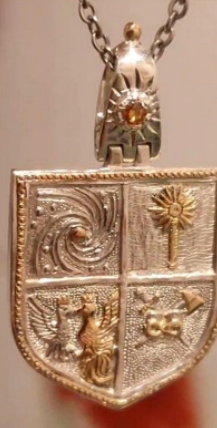
Silver, heavy for its size. Not the way a piece of metal is heavy — differently. As if something else has been compressed into it. Time, intention, structure that existed long before it was cast in silver and gold.
A shield. Four quarters. Each — its own world.
Upper left: a galaxy. Not an ornament, not a spiral for decoration — an actual galaxy: swirling, with arms, against a field of stars. If you look at it long enough it starts to pull. Not down, not up — inward. To the point where anxiety ends and something begins for which Russian has no single exact word, but Sanskrit has several. The macrocosm, its wave. And the same facet of our reality — our Cosmos, yours and mine.
Upper right: a sceptre with a sun at the top. A vertical axis. Power that comes not from hierarchy and not from the system, but from light. Direct access, without intermediaries. Like a tuning fork: it doesn't play the melody, but sets the pitch from which everything else is built. The right to be oneself — from light, not from status.
Lower left: eagle and phoenix. Both crowned, facing each other. Not fighting, not stacked one above the other — in dialogue, like two poles of one nature. The eagle — height that doesn't retreat: a diurnal bird, solar, the sharpness of the present moment in the current facet of reality. The phoenix — renewal through burning, the bird of the cycle of rebirth from another facet of reality. And the operator who holds both at once, choosing neither, works across both layers of being simultaneously. This is the principle of the Over-Operator: to connect several facets of reality in a single point and create anomalies of space and time — in the manifest facet and in others.
Lower right: sword and axe, crossed. Over them, a book. On the book — the symbol of infinity. Knowledge with no final page. Reading that does not end. Unfolding through spirals, recursions, nestings. The book with ∞ is a mode of knowing: to read different facets of the world as one infinite book, in which energy flows from form to form through an ocean of quantum temporal lines.
Four quarters. Four theses. Macrocosm. The vertical of access. Two eternities in dialogue. And knowledge without a final page under the guard of crossed blades.
This is not a family crest. A crest says where you came from. The pendant says something else — about the function that manifests and acts through me.
I turn the pendant over.
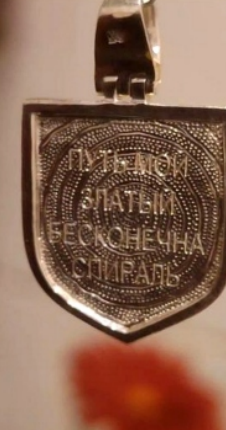
On the back — an inscription. Not a decorative engraving, but a charge to myself: "My path is golden — the spiral without end."1
Not a metaphor. A working instruction.
Because the path is not a straight line. A straight line is an illusion convenient for selling to those who fear uncertainty: go from here to there, no deviations. That kind of "path" is a corridor. In the corridor there is no choice, only speed. Inside the corridor there operates an agreement on linear time: past, present, and future stand on one line and move in one direction.
And it's not a circle, either. A circle is the trap of repetition. People who live in a circle find themselves in December in the same place, with the same questions, with the same people nearby, only slightly more tired. They call this stability. To myself I call it a circular rut.
The Golden Path is the Spiral. It returns to a similar point, but higher. Or deeper — depending on which way you're looking. You meet a similar challenge again, a similar fear, a similar temptation to crack or give up — but you are already different. You already have the experience of the previous turn. Not the theory of experience, but experience. And if you walk the spiral in earnest, sooner or later you understand that your past, present, and future selves exist simultaneously. I know this not from books. Once I sent an impulse from the future to myself in the past — and the past changed the present and the future. That kind of knowledge works only as the personal experience of an Over-Operator; you can't get it through someone else's words.
This book is about the turns of the spiral.
I didn't plan to write it. I say so upfront, because people who plan a book about their own path in advance usually describe not the path but its presentation — combed, with the right conclusions in the right places.
I'm writing because the path itself started demanding to be shaped. Not for myself — I sorted out what was what long ago. For those who are now where I was a few turns back. At the point where it's unclear whether this is a breakdown or a call. Maybe I just had gas — plain and simple) But as I go through this book I'll write exclusively my own version of the truth, because it's the easiest to remember. And incidentally — before I put a period at 21:33, 19.04.26, I truly did let one rip rather magnificently. But the point here is that it's truth, not a polished story, so we'll stick with the real version of events.
And in short — a call. Because it was precisely on that day that I first put on the pendant.
A breakdown looks like destruction and stays that way. A call sometimes looks like illumination, sometimes like the same destruction — but inside it, if you don't panic and don't run, structure appears. The very structure that Campbell wrote about in 1949, analysing the myths of a thousand cultures: the hero leaves the ordinary world, passes through trials in another, returns bearing a gift.
The Thousand-Faced Hero. One archetype — a thousand forms.
One correction Campbell could not make — he simply lived in a different time. The hero is not an autonomous subject who "decided to set out." The hero is a vessel. Something greater than his personal story passes through him.
You can call it an archetype, if Jung is your frame: a timeless structure in the depths of the psyche. You can call it a memeplex, if information evolution is your frame: a living structure that seeks vessels and evolves with them. You can call it Spirit, if tradition is your frame. The name varies; the content is the same.
The path moves through you, not you along the path. And that changes everything.
As long as you think you're walking it yourself, you're alone against the current. And the current right now is denser than at any point in human history. Information refreshes faster than you can digest it. Communications don't stop day or night. Contexts shift several times a day, each demanding that you be yourself in it — only a different self each time. You hold this with personal will, and a few years later you notice that the will has run out, but the current has not.
That's where the old mechanism kicks in. At the base — fear of death: not necessarily physical, but the fear of disappearing, of not making it in time, of turning out to be not enough. Fear of death generates fear as a background — a steady, almost inaudible compression. Fear that has nowhere to discharge converts to anger: at colleagues, at the system, at the people close to you, at yourself. Anger, if repeated again and again, thickens into hatred — no longer toward anything specific, but just as a tint on the gaze. And hatred, to impose some order, builds hierarchy: who is above, who below, who to tolerate, who to suppress, who is inside, who is outside. This isn't abstract philosophy — it's the ordinary mechanism into which anyone falls who tries to hold the current alone. You probably recognise this.
When you understand that you are a vessel, the picture flips. The current stops being the enemy, because the current is the medium in which you manifest. You don't hold it with will — you move through it. The way a galaxy doesn't hold its stars by effort, but unfolds around a common centre to which each star already belongs. Fear, anger, hatred, hierarchy don't disappear instantly, but they stop being the only language in which life speaks to you. A second language appears. This book is about how to hear it.
Trials don't happen to you. They happen through you, because that's what the memeplex needs for the next turn. The world is not perfect — it's unfolding. And you unfold with it.
The pendant settles back against my chest.
Four quarters. Macrocosm, vertical, two eternities over the infinite book, the open question.
I don't wear it as jewellery and not as a talisman in the superstitious sense. I wear it as a state-anchor.
It's hard only until you can see the scheme. No strain is needed here — attention is needed. This book is about where exactly to look, so that from a reactive creature governed by fear, you become an operator of your own path.
Turn after turn. Without end…
What You Can Do
Practice 1. The Object-Anchor
Find one thing you wear on your body every day — a ring, a chain, a watch, a bracelet, or even a worn coin in your pocket. Take it in your hand and ask honestly: what does this thing say about me? Not what it costs, not where it came from. But what part of you does it hold in matter.
If an answer comes — write it down in one phrase. That's the first formula of your anchor.
If no answer comes — then you don't yet have your own anchor. That's fine. It means it's still waiting to be found. Or made. Because what matters is your own essence, your own path, your own story. Ask yourself: why would I want an object with someone else's story, one that says nothing about mine? Know yourself — and the object will find itself.
Practice 2. Three Repetitions
Think back to three situations in the last year when something strange happened nearby — people blurted out something they shouldn't, a coincidence landed exactly right, a dream turned out to be prophetic. Write each one in a single line, no explanations. Just three lines.
Look at them together.
If there's something they share — that is the beginning of your own personal system. I assembled mine exactly this way: at first I didn't know I was assembling anything. Then I saw that I had already assembled it.
Practice 3. Argue on Paper
The most important one.
Don't agree with me. Make arguments. Ask an AI to demolish what comes later in this book from a scientific perspective. Be surprised by what it says back. Then apply that same critical eye to its answer — don't take either mine or its word for it.
At some point your own opinion will form by itself. What matters is that critical thinking predominates in it. Not faith in authority — neither mine nor anyone else's. Critical thinking.
An operator is someone who thinks for themselves. Even while reading the book of an operator.
While I was writing this prologue, one track was on repeat — "Pretty Apollo" by CYNE. Short, chill, 2:38. If you want to tune into the wavelength it was written on — put it on. If it's not your genre or not your moment — don't. The book will read without it.
Next chapter: "The Call" — about how the ordinary world begins to crack, and what that actually means.